Neil Gaiman, Chris Ware, Carrie Fisher, Alex Ross and countless others from young hotshots like Jimmy Cheung to the old guard like Colleen Doran (whose table I worked at Ithacon around 20 years ago, but that's another story) were among the guests of honor here. I didn't get to meet any of them, though. Apparently C2E2 is a controversial corporate upstart to the established Chicago Comicon nee Wizard World. Here's what I learned while I was there.
As a graphic novel selector, I just had to attend C2E2, a spin-off of the New York Comicon and I certainly wasn't disappointed. I was only there for a few hours and, as well as picking up some ideas for the collection, I saw a wide and fascinating tapestry of human interests. For a change, though, librarians stood out as the most normal people in the crowd.
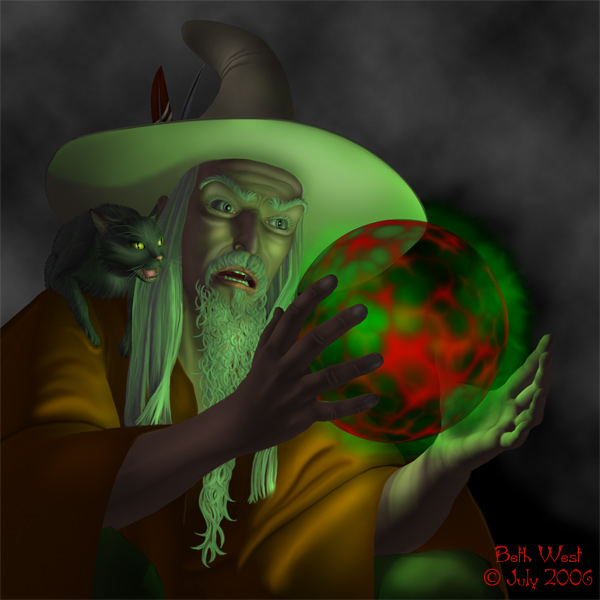
I saw work by artists like this guy but also got to shake hands with none other than Playboy cartoonist Doug Sneyd who made me giggle when I was a young boy sneaking a peak at my dad's magazines. Speaking of laughs, I wondered what the Windy City Jedi group was. I saw they would be performing later, but as a professional relegated to a few pre-convention hours, I was only able to stop by the exhibition floor booth to say "hey" as they set up. Apparently, they're stationed out of Rolling Meadows, IL and probably eager to do battle for Carrie Fisher, who would be signing autographs later.
But all in all, as a people-watcher, I had a ball; these are creative individuals who clearly seek and love attention. I saw a young lady with the crowd-stopping combo of dominatrix boots and a wee Captain America shirt. Another was getting a bustier fitting. There were a lot of funny hats. A few utility kilts. Several potbellies, mustaches, and clever t-shirts were on display. On the way out of an excellent presentation (details below), a young lady in a snug-fitting Batgirl costume chatted with another person, perfectly natural--as if she had just bumped into an old friend at the mall. On the way out of McCormick Place I saw another young lady attaching the pieces to her Stormtrooper outfit in the bright open air near the Lake Shore Trail. Really, the wide tapestry in so many ways...
The exhibitors were all pretty interesting; a lot of the long, white boxes I remember thumbing through for that old issue of The Avengers. Speaking of Marvel, they floored me with their supermodel greeters in slinky black cocktail dresses who approached all geeks with a come-hither smile. Conversely, the only booth of indy comics was the wonderful Quimby's/Chicago Comics, which took up about a tenth of Marvel's real estate, looking like a lemonade stand by comparison. The people I saw seem to spend a lot more time reading than exercising. Serving the broken-down masses, a foot specialist and chiropractor's booth were there to aggressively offer their help in picking up the pieces.

Graphic Novels 101 by John Shableski
2010 is a big year for graphic novels due to:
- Disney buying Marvel for $4 billion.
- James Patterson creating a comic, mostly for a son who has trouble reading, Evanovich, Meyer, and Captain Underpants follow his lead.
- The Texas Library Association introduces the Maverick Award--the first formal recognition for the format, part of the Texas Young Adult Round Table. I wonder if he hadn't heard of the Eisner award? I guess it's more formal than YALSA, according to what he says...
Also, some more pre-history...
50,000 years ago Cave Paintings in Lasceaux, France.
1000 AD, Monks draw satirical bunnies
1817 Martin Luther draws satirical cartoon vs. the Pope as money changer.
Colonial Era. Ben Franklin communicates through pictures and words (i.e. “Join or Die.”)Late 1800s Literacy in America. Mark Twain publishes The Innocents Abroad
--The first writer to use American dialect. Rails connect both coasts. US education system formalizes, we are at 97% literacy (among whites, anyway.)
1870's Thomas Nast uses panels. Almost killed for cartoons on Boss Tweed. Also helped popularize Saint Nick and Uncle Sam.
1895 Yellow Journalism and New Kind of Literacy. “Yellow Kid” character wore a t-shirt that featured social commentary
1920-1930 Comic Books and Superheroes. Comic strips and comic books took off; Dick Tracy emerged.
1938 Action Comics. Birth of Superman.
Late 1940's The Cold War, Sputnik, Horror, Scifi, UFO's, HUAC hearings, Hollywood Blacklisting, Manga, and the Library Bill of Rights. Sci-fi and horror comics gain momemtum while superhero comics become not as popular. Manga emerges with elements of Disney and western influence.

1950s The Seduction of the Innocent and the CCA. Dr. Federic Werham, publishes this book in 1954, his place as the era's Dr. Phil is cemented. Wertham is credited for the comic book industry’s decline (at 10 cents each, they were selling $53 million/year!) In a remarkably unscientific study, he blamed comics as a contributing factor to juvenile delinquency. The industry countered with the Comics Code Authority in 1957. DC and Marvel Comics wrote the code which advocated for less violence and gore. Self serving because they were promoting their comics (i.e. superheroes rather than vampire storylines).
1960 Mad Gets Even. Stan Lee (a conflicted novelist creates many comics filled with conflicted superheroes like Spiderman and the X-Men ) started in comics when he was just 19. Mad Magazine was created. Other comic emerge outside of the Marvel stable and go underground. These alternative comics are sold at head shops.
1980s Great expectations. The industry rebounds with critically acclaimed Watchmen, Sandman, Maus, The Dark Knight Returns.
1990s A Collectors Paradise, Bone, Emerging Voices and the Arrival of Manga. More of an industry for collectors emerged where limited edition runs of comics with sophisticated artwork and high glossy paper dominated the landscape. Superman got killed. Manga got traction with the Internet with Pokemon and Naruto helping.
2000s New Age and the Library Market. Not quite a mature industry. Comic book industry is evolving with support from libraries, popular culture. It’s finding a new audience. Web comics become popular. Increased support from major academic institutions, major literacy organizations like NCTE and IRA.
--Also increased volume of reports, papers, articles & websites:
Graphic Novels in the classroom (500,000)
Teaching with Graphic Novels (3.3 million)
Graphic Novels in Education (5.3 million)
Graphic Novels for Reluctant Readers (319,000)
Graphic Novels for autistic/spectrum disorders (64,000)
At John Shableski's hometown library (Williamsport, Penn) graphic novels circulate at 7 to 1 over bestsellers. This was after they were moved to better sections and marketed properly. Patrons seek graphic novels out for a variety of reasons. Libraries are headed in this direction for sure with manga leveling off and normalizing in terms of quality and popularity and the mainstreaming of both independent and mainstream comics.

Art Form:
Garage Band Effect ~
Kids create their own books
without inhibitions..